My name is Andrei, I have ADHD, and I have broken more morning routines than I can count.
I've tried the 5 AM club (okay, that was 6 - but still). I've tried the "miracle morning" with its six steps. I've tried habit stacking, time blocking, and putting my alarm across the room. Each one worked for about a week. Then one bad night, one early meeting, one "just five more minutes" — and the whole thing collapsed. Not gradually. Instantly.
If you have ADHD, you probably know the pattern. The routine isn't the hard part. Restarting after you break it is.
After years of this cycle, I've found a few principles that actually survive the ADHD brain. They're not Instagram-worthy. But they work on the days you need them most — the low-dopamine, can't-get-out-of-bed, why-is-everything-so-loud mornings.
Why generic morning routines fail ADHD brains
Most morning routine advice is written for neurotypical brains. It assumes you can:
- Wake up and immediately make decisions
- Remember what you're supposed to do next
- Follow a sequence without getting sidetracked
- Feel motivated by a streak counter
None of that is how ADHD works.
Our brains wake up slowly. Executive function — the part that plans, sequences, and initiates — is often the last thing to come online. So the moment you ask yourself "what should I do first?", you've already created a decision point. And decision points are where ADHD mornings die.
The second problem is all-or-nothing thinking. Miss one step and the whole routine feels ruined. "I skipped the journaling, so I might as well skip the workout too." Neurotypical advice says "just get back on track." ADHD brains don't work that way. A broken streak feels like a personal failure, and failure kills momentum.
Rule 1: Remove every decision you can
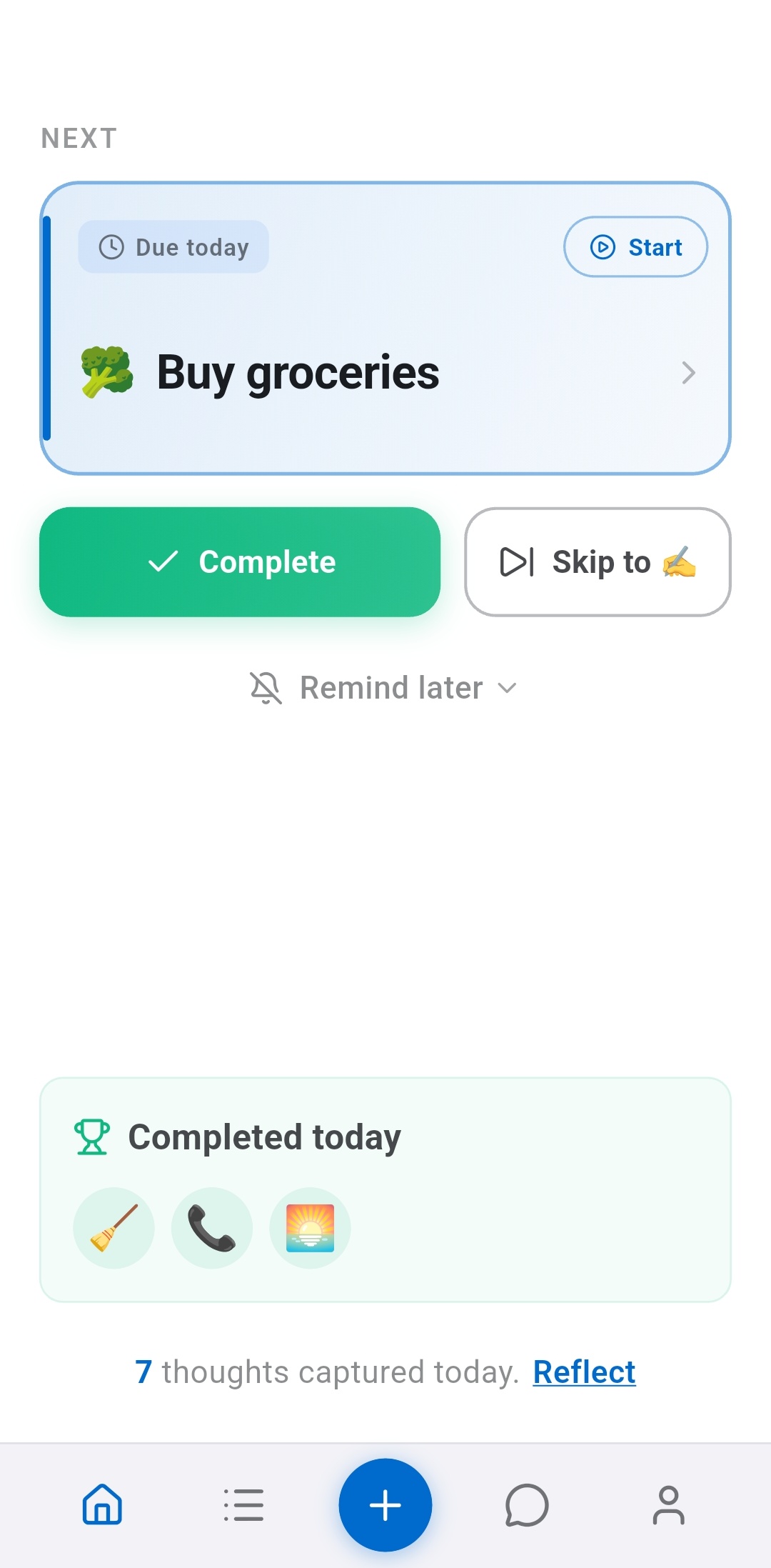
The fewer choices in your morning, the better. Every decision — what to eat, what to wear, what order to do things — costs executive function you don't have yet. Some people pre-decide all of it. Others just reduce the big friction points. Either way, the principle is the same: mornings are not the time to think.
A fixed sequence helps enormously. Instead of a checklist of twelve items you scan and choose from, show yourself one thing at a time. Not "here are your 8 morning tasks" — just "brush your teeth." Then the next thing. Then the next.
The difference is enormous when your prefrontal cortex is still asleep.
Rule 2: Expect failure and make restarting trivial
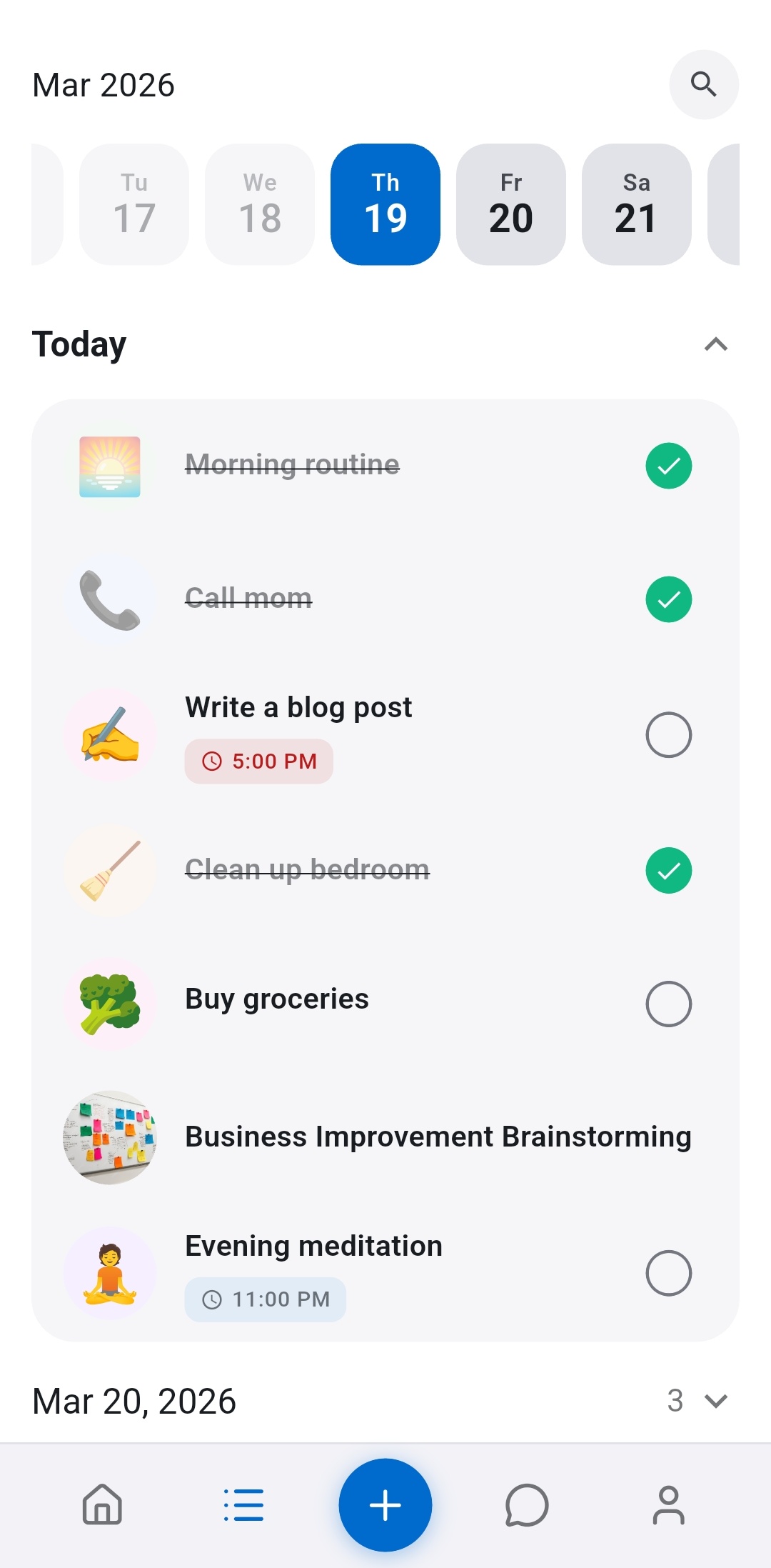
Most routines are designed around perfection. Hit every day, maintain the streak, don't break the chain. For ADHD, this is a trap. The routine doesn't break when you skip it. It breaks when you stop restarting.
A morning routine that works 4 out of 7 days is infinitely better than one that works 7 out of 7 for two weeks and then disappears forever.
Things that help:
- No streak counters — streaks punish failure instead of rewarding consistency
- Automatic roll-forward — tomorrow's routine shows up regardless of what happened today
- No catching up — if you missed three days, you don't make up for them. You just do today.
The mindset shift: missing a day is part of the system, not a failure of it.
Rule 3: Make the first step embarrassingly small
Don't start your routine with meditation or exercise. Start with drinking a glass of water. Opening the blinds. Putting on socks.
The reason is simple: starting is the hardest part. Once you complete one thing — anything — the activation energy for the next thing drops. This is called behavioral momentum, and it's one of the few productivity concepts that actually works with ADHD.
If your first routine step requires willpower (cold shower, 30-minute workout, journaling), you'll skip it on hard days. And when you skip the first step, you skip everything.
Start with something so easy it feels almost stupid. You can always add harder steps later, once the habit of starting is automatic.
How to build your own ADHD morning routine
Start with just 3 things
Not 8. Not 12. Three. Pick three things you want to do every morning, and do only those for at least two weeks. Your brain needs to automate these before you add more.
The urge to build a comprehensive routine from day one is strong — resist it. ADHD brains love the planning phase. The dopamine hit of designing the "perfect" routine feels productive, but complexity is the enemy of consistency.
Make it visible
Don't rely on memory. ADHD and remembering sequences are not friends. Put your routine somewhere you'll see it the moment you wake up.
A sticky note on your mirror. A recurring task on your phone that shows one step at a time. Whatever works — the point is your brain should never have to recall what comes next.
Build in recovery, not guilt
Every routine system should assume you'll miss days. The question isn't "how do I never miss?" — it's "how do I make it easy to restart after missing?"
Traditional habit trackers work against this. They show an unbroken chain, and when the chain breaks, motivation vanishes. What works better is a system that simply presents today's routine fresh, every morning, with no memory of yesterday's failure. Roll forward, not roll back.
Attach it to an anchor
"After my alarm goes off" is too vague. "After I put my feet on the floor" is better. Anchor your first routine step to a physical action you already do. This is the one piece of habit stacking advice that actually works for ADHD, because it bypasses the "remember to start" problem.
When the routine falls apart mid-step
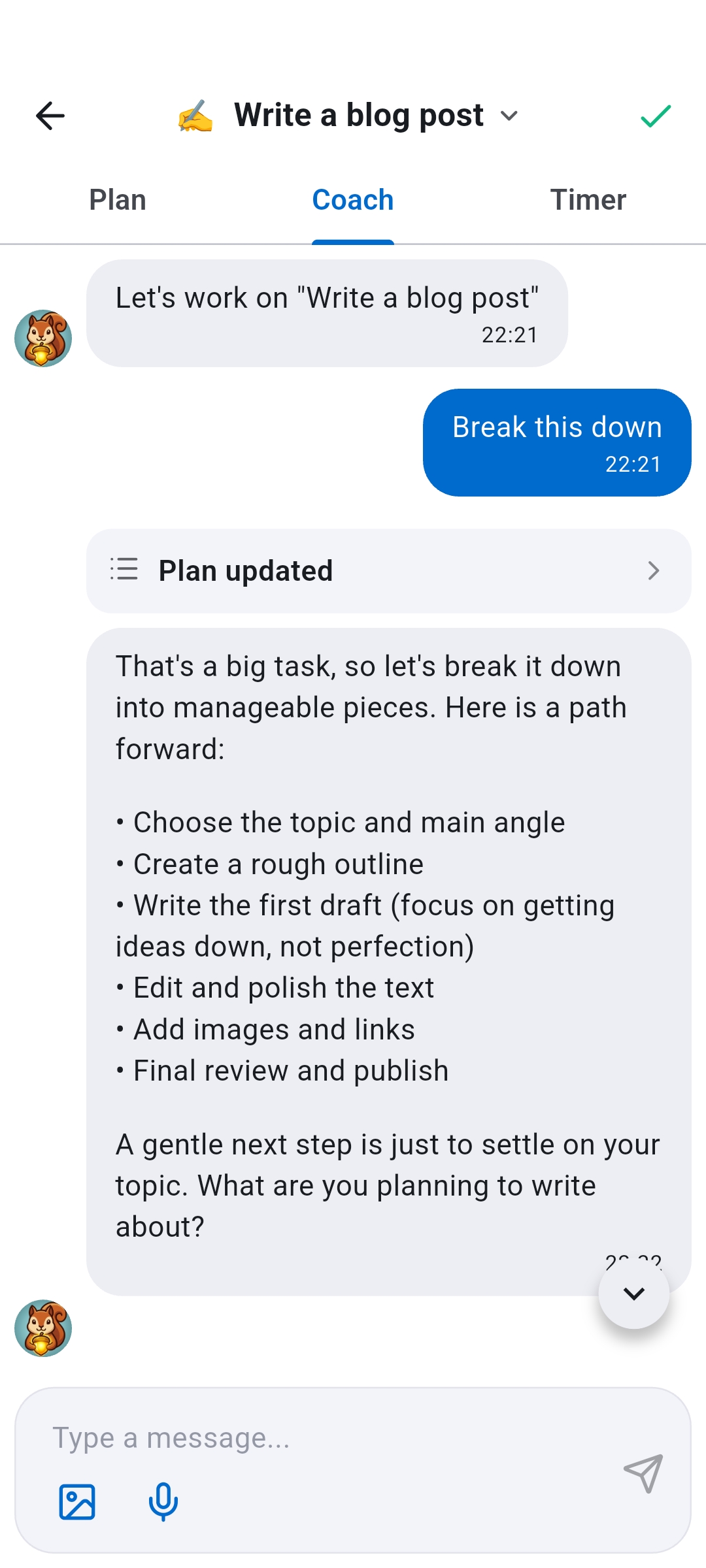
Even a well-designed routine will hit a wall sometimes. You're three steps in and then — a notification, a stray thought, a sudden wave of "I can't do this today." Five minutes later you're scrolling your phone and the routine is gone.
This is where most systems abandon you. The checklist doesn't care that you got derailed. The timer kept going. There's no one to say "hey, you were brushing your teeth — just finish that and move on."
What actually helps in that moment is not willpower. It's a nudge back. Something that meets you where you are — stuck, distracted, maybe frustrated — and gives you the smallest possible next action. Not "redo the whole routine." Just: what's the one thing you can do right now?
This is why I built a coaching feature into Recordo's task execution mode. When you're working on a task or routine and you get lost, you can literally tell the AI coach "I got stuck" and it pulls you back in. It knows what you were doing, what's left, and how to break "resume" into something small enough to actually start. No judgment, no shame spiral — just "here's your next move."
It won't fix every derailed morning. But having something that actively helps you restart — not just track whether you did or didn't — changes the dynamic entirely.
What about medication mornings?
I'm not medicated, so I can't speak from personal experience. But from what I hear from other ADHDers: if you take morning medication, your routine should be designed for before the medication kicks in. That means: even simpler, even fewer decisions, even smaller steps.
Some people set a medication alarm 30 minutes before their "real" alarm, take the pill, and go back to sleep. By the time they get up, executive function is more available. Talk to your doctor, not a blog post.
The real secret: lower the bar
Every productivity influencer will tell you that successful people have ambitious morning routines. Maybe. But they probably don't have ADHD.
Our win condition is different. It's not "I completed a 90-minute morning ritual." It's "I got out of bed and did the first few things before my brain had time to talk me out of it."
Remove decisions. Expect failure. Start embarrassingly small.
Your morning routine doesn't need to be impressive. It needs to survive Thursday.
I built Recordo to help with exactly this. It shows you one task at a time, rolls routines forward automatically, and never guilt-trips you for missing a day. If you're looking for a routine system designed for ADHD brains, not against them — give it a try.
FAQ
How long should an ADHD morning routine be?
Start with 5-15 minutes. Three to five small steps. You can always expand later, but a short routine you actually do beats a long one you abandon after a week.
What's the best morning routine app for ADHD?
Look for something that shows one task at a time (not a long checklist), supports recurring tasks, and doesn't rely on streaks or guilt. Recordo, Tiimo, and Structured are popular options in the ADHD community — each works differently, so try what fits your brain.
Why can't I stick to a morning routine with ADHD?
Probably because the routine has too many steps, too many decisions, or no recovery plan for missed days. ADHD brains struggle with initiation, sequencing, and all-or-nothing thinking — all of which make traditional routines fragile. The fix is designing a routine that expects you to break it.
Should I do the hardest thing first in my morning routine?
No — the opposite. Do the easiest thing first. ADHD brains need behavioral momentum. Completing one trivial task makes the next one easier to start. Save hard tasks for after your routine, when you're warmed up.
What do I do when I get distracted mid-routine?
Don't restart from the beginning. Pick up from wherever you left off — or skip to the next step. The goal is finishing some of the routine, not doing it perfectly in order. If you struggle to re-engage on your own, an AI coach (like the one in Recordo's Momentum Mode) can help you find the smallest next action to get moving again.
Is it okay to have a different routine on weekends?
Absolutely. In fact, trying to force the same routine every day often backfires. A simpler weekend version (even just 1-2 steps) maintains the habit without the rigidity that leads to burnout.
Stay in the Loop
Get Recordo updates and ADHD productivity tips. No spam, unsubscribe anytime.