
If you have ADHD, you probably know the small costs by heart: the missed turn, the burned pan, the refill you meant to order last week. A large new review added them up over a lifetime, and the total is not small.
It also points at where the extra risk comes from, and most of it is ordinary enough to work on.
Across 16 million people, ADHD was linked to a shorter life
Researchers at University College London and the University of Liverpool pooled 19 studies from three continents, covering nearly 16 million people. It was published in JAMA Network Open on October 19.
People with ADHD had a 71 percent higher risk of death from any cause over the years they were followed. The gap showed up in every kind of death the team could separate: about 1.9 times the risk of suicide, about 1.5 times the risk of dying from an injury, and a smaller, 27 percent rise in deaths from illness.
The size of the gap varied a lot between countries and studies. The direction did not: every single study found more deaths in the ADHD group.
That is a comparison between groups, not a forecast. Early death is rare to begin with, so for most people with ADHD a higher risk still means a long life.
The reasons are ordinary, not mysterious
The authors do not blame a hidden flaw in the ADHD brain. They list things you will recognize.
Suicide risk tracks the depression, anxiety and substance problems that often travel with ADHD, plus years of stigma and a quicker path from impulse to action. Injuries track attention and impulsivity, including a higher rate of serious traffic accidents.
Illness is the slowest route. Smoking, a rougher diet and poor sleep play a part, and the authors add one that is easy to miss: trouble with attention and organization makes it harder to stick to a treatment plan, keep appointments and use health care at all. A missed check-up is not dramatic. Missed for ten years, it can be.
People on ADHD medication died less often, with a large asterisk
In the studies that compared people with ADHD who took medication with those who did not, the medicated group had about a quarter lower risk of death.
The asterisk is that only 3 of the 19 studies could answer this, and people who get treated tend to differ from people who do not, in money, access to doctors and how severe their difficulties are. The authors say plainly that this does not prove the medicine itself saves lives.
The riskiest stretch came before the first prescription
A separate study, published in BMJ Mental Health in September, looked at the question from another side. It followed 461,024 people who started ADHD medication in Hong Kong, New Zealand, South Korea, Taiwan and the UK, and asked when self-harm happened.
The risk was highest in the 90 days before they started treatment, about 2.6 times their usual level. It was lower in the first 90 days on medication, and lowest after that. Whatever drives that risk, the researchers concluded, it is not mainly the medicine. The hardest time looked like the stretch of struggling before help arrived.
If you are in that stretch, waiting for an assessment and having thoughts of hurting yourself, do not wait for the appointment. Contact a crisis line now: in the US call or text 988, in the UK and Ireland call Samaritans on 116 123, or use your local emergency number.
The boring tasks are the protective ones
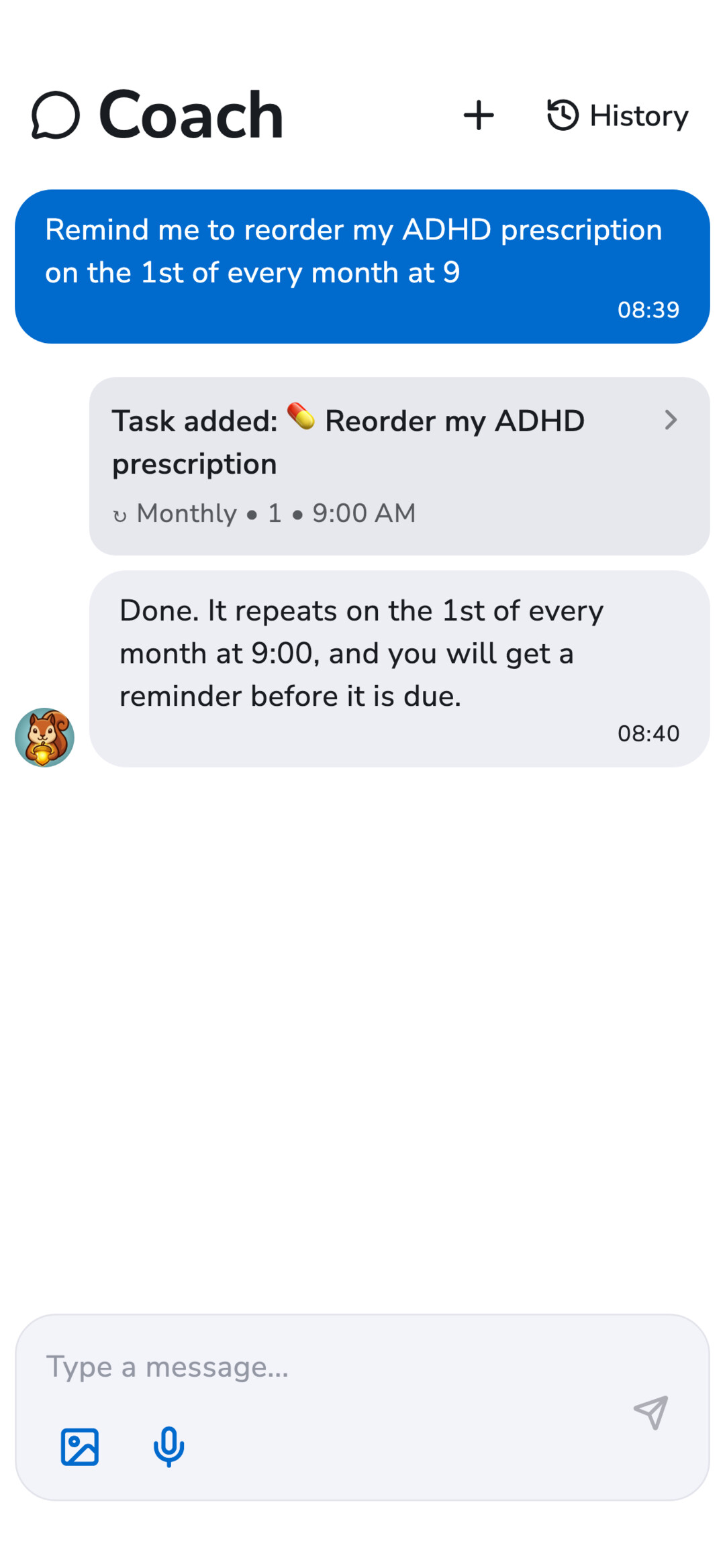
The review's own list of risks includes the admin that ADHD makes slippery: the prescription that runs out, the blood test you were told to book, the follow-up nobody chases. None of it feels urgent on the day, which is exactly why it slides.
In Recordo, you can hand those to Coach in one sentence, for example "Remind me to reorder my ADHD prescription on the 1st of every month at 9" (use your own day and time). It becomes a repeating task with a reminder, so the refill shows up before you run out instead of after. The same works for the once-a-year things: "Remind me to book a check-up with my doctor in January."
Our previous ADHD news story looked at what a large US study found about ADHD and memory later in life.
A higher risk is a reason for support, not fear
The new review does not say that ADHD is dangerous in some mysterious way. It says that ADHD makes ordinary risks a little more likely, every year, for decades: a darker month without help, a faster drive, a skipped check-up. Each of those has a fix that is ordinary too, and the earlier it starts, the better it looks. A reminder for your next refill is a small place to begin.
Sources
- Corrigan L, Heywood L, Stewart GR, O'Nions E, Shelford H, Stott J, John A. Mortality Among People With Attention-Deficit/Hyperactivity Disorder: A Systematic Review and Meta-Analysis. JAMA Network Open, published October 19, 2026. doi:10.1001/jamanetworkopen.2026.39448
- Chan AYL, Beyene K, Park S, et al. ADHD medication use and risk of self-harm: a multinational self-controlled case series study. BMJ Mental Health, September 12, 2026. doi:10.1136/bmjment-2026-302819
Discussion
Loading the conversation…
Open the discussion in the Recordo community