
If you have ADHD, you might know this pattern. All day you are foggy and slow. Then late in the evening, long after you should be winding down, your head finally clears and you want to work.
So you work. Then the alarm goes off and the whole day starts in deficit. You have probably been told this is a discipline problem.
It usually is not.
Your body clock really does run late
Researchers can measure when your body starts releasing melatonin, the hormone that tells your brain night has arrived. It is called dim-light melatonin onset.
In adults with ADHD, that signal arrives around 90 minutes later than in adults without ADHD. In children the gap is closer to 45 minutes. Core body temperature and activity rhythms are shifted later as well.
So the late-evening clarity is not imagined, and it is not a habit you picked up. Your internal night simply starts later than the calendar's does.
A 2019 review reports that a delayed sleep phase affects roughly three quarters of children and adults with ADHD. Treat that as a broad estimate rather than a precise count. The direction is not in doubt.
Why standard sleep advice keeps missing
Most sleep advice treats late nights as a habit. Dim the lights, no caffeine late, keep a consistent bedtime. All sensible, and all beside the point if your clock itself is shifted.
You can follow every item on that list and still lie there awake, because you are asking your body to sleep before its own night has started.
It is also worth knowing that clinical guidance on ADHD covers sleep very thinly. The main UK guideline says little more than that sleep patterns should be monitored, with a sleep diary, and medication adjusted accordingly.
That is part of why the advice you get tends to be generic.
The damage is the lost sleep, not the late clock
This part is worth being precise about, because it changes what you should aim at.
A late clock by itself is not harmful. The problem starts when an early schedule is bolted onto it. Researchers call that gap social jetlag: your body keeps one timetable while your life runs another.
For evening types, that means chronic sleep restriction, and sleep debt that accumulates instead of resolving. It shows up as daytime sleepiness and, in adults, as worse ADHD symptoms and more impulsivity.
So the useless daytime fog is a predictable result of the squeeze, not a separate personal failing.
One caveat. In some people with ADHD, daytime sleepiness is not fully explained by lost sleep. That is a reason to raise it with a doctor rather than assume.
What actually shifts the clock, and what it does not do
The clock can be moved. Low-dose melatonin in the evening and bright light in the morning both shift that melatonin onset earlier. Combined, trials have moved it by around two hours.
Now the honest part, from a trial run on adults with exactly this combination of ADHD and a delayed sleep phase.
The clock moved. Sleep did not. The researchers found that sleep and wake times had not shifted along with the internal clock. And two weeks after treatment stopped, the clock had drifted back to almost precisely where it started.
Their conclusion was that this kind of treatment needs behavioural work alongside it to actually change when you sleep.
That is the thing to take from all of this. Moving the clock is not the same as changing your night. The scaffolding around it is not optional extra credit. It is the half that makes the other half hold.
What to try, depending on how much your schedule bends
If your schedule can move
If you have real control over when your day starts, the simplest approach is to stop fighting the shape of your clock and put demanding work in the window where your head is actually clear.
There is a genuine effect here, though the research is messier than the internet suggests. Evening chronotypes do tend to do worse on attention and self-control tasks when tested early in the day.
But it is inconsistent. That pattern shows up in fewer than half of studies in younger adults, and one recent review found no reliable across-the-board boost from matching tasks to your chronotype.
So try it, and judge it on your own results rather than on the promise.
And do not read a bad morning as proof of anything about your brain. Being tested at the wrong end of your own day is enough to make anybody look worse on paper.
If your schedule cannot move
School. An early shift. Other people who depend on you being up. Most of the time the schedule is simply fixed, and every article about honouring your natural rhythm is useless.
If that is you, change the target. Stop trying to protect the productive window and start protecting sleep length.
This feels backwards, because the late window is the only time anything gets done. But the fog you are trying to fix is coming from the sleep debt. Reclaiming two good hours tonight costs you more than it returns tomorrow.
In practice: take the wake time you cannot move, count backwards, and treat that bedtime as the fixed thing the rest of the day is built around, rather than as the leftover at the end.
How to set this up in Recordo
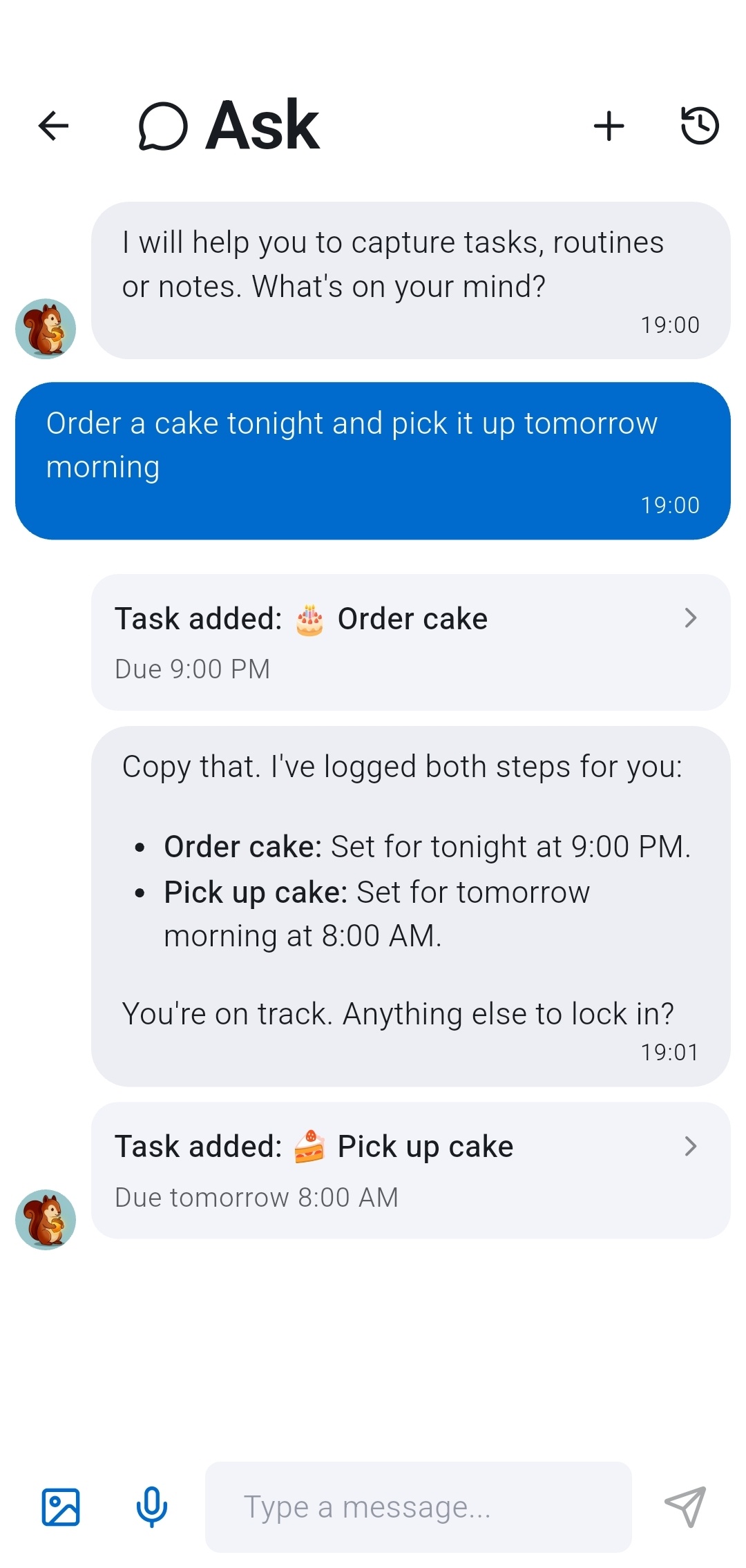
Recordo will not shift your body clock. What it can do is hold the scaffolding, and the scaffolding is the half that collapses first after a bad night.
The quickest way in is to tell the coach what you want, in the chat, in your own words. For example:
- "Create a daily wind-down routine at 10pm: phone across the room, clothes out for tomorrow, lights down."Use whatever time is about an hour before you actually want to be asleep. It gets saved as a recurring routine, so it comes back every evening without you rebuilding it.
- "Help me plan tomorrow."Do this before your late window opens. Then the clear-headed hour goes on the work itself, instead of on deciding what the work is.
- "Move my morning tasks to the afternoon and keep tonight free."Rescheduling by asking is quicker than dragging things around when you are already tired.
Two settings are worth changing once:
- In your profile, set Default task reminder to something that gives you a runway rather than a starting gun. 30 mins before or 1 hour before beats a reminder that arrives exactly when the thing was meant to happen.
- Any single task can override that under Reminder, which is worth doing for the ones you already know you will avoid.
And if you want to find your own pattern rather than trust an average, use "Let's reflect on my day so far" in the chat for a couple of weeks. Which days actually went badly will tell you more than any figure I can quote.
When to talk to a professional
Worth raising with a doctor if you cannot fall asleep no matter when you go to bed, if daytime sleepiness is severe or unsafe, or if you think your medication timing might be involved.
Keep a sleep diary for a couple of weeks first, noting when you actually fell asleep and actually woke up.
It is the one thing the guideline explicitly recommends, and it turns a vague complaint into something a clinician can work with.
Key takeaway
Your clock runs late. That is measurable, not moral.
You can shift it, but shifting it will not move your sleep on its own, and will not hold once you stop. And if your schedule will not budge, protect the sleep rather than the productive hours.
Sources
- Bijlenga D, Vollebregt MA, Kooij JJS, Arns M. The role of the circadian system in the etiology and pathophysiology of ADHD. ADHD Attention Deficit and Hyperactivity Disorders, 2019.
- Luu B, Fabiano N. ADHD as a circadian rhythm disorder: evidence and implications for chronotherapy. Frontiers in Psychiatry, 2025.
- Coogan AN, McGowan NM. A systematic review of circadian function, chronotype and chronotherapy in attention deficit hyperactivity disorder. ADHD Attention Deficit and Hyperactivity Disorders, 2017.
- Lugo J et al. Sleep in adults with ADHD: systematic review and meta-analysis of subjective and objective studies. Neuroscience and Biobehavioral Reviews, 2018.
- van Andel E, Bijlenga D, Vogel SWN, Beekman ATF, Kooij JJS. ADHD and delayed sleep phase syndrome in adults: a randomized clinical trial on the effects of chronotherapy on sleep. Journal of Biological Rhythms, 2022.
- Vogel SWN et al. Sleep quality, chronotype and social jetlag differentially associate with symptoms of attention deficit hyperactivity disorder in adults. Chronobiology International, 2016.
- May CP, Hasher L, Healey K. For whom (and when) the time bell tolls: chronotypes and the synchrony effect. Perspectives on Psychological Science, 2023.
- The interplay of time-of-day and chronotype results in no general and robust cognitive boost. Collabra: Psychology, 2023.
- National Institute for Health and Care Excellence. Attention deficit hyperactivity disorder: diagnosis and management (NG87).
Discussion
Loading the conversation…
Open the discussion in the Recordo community