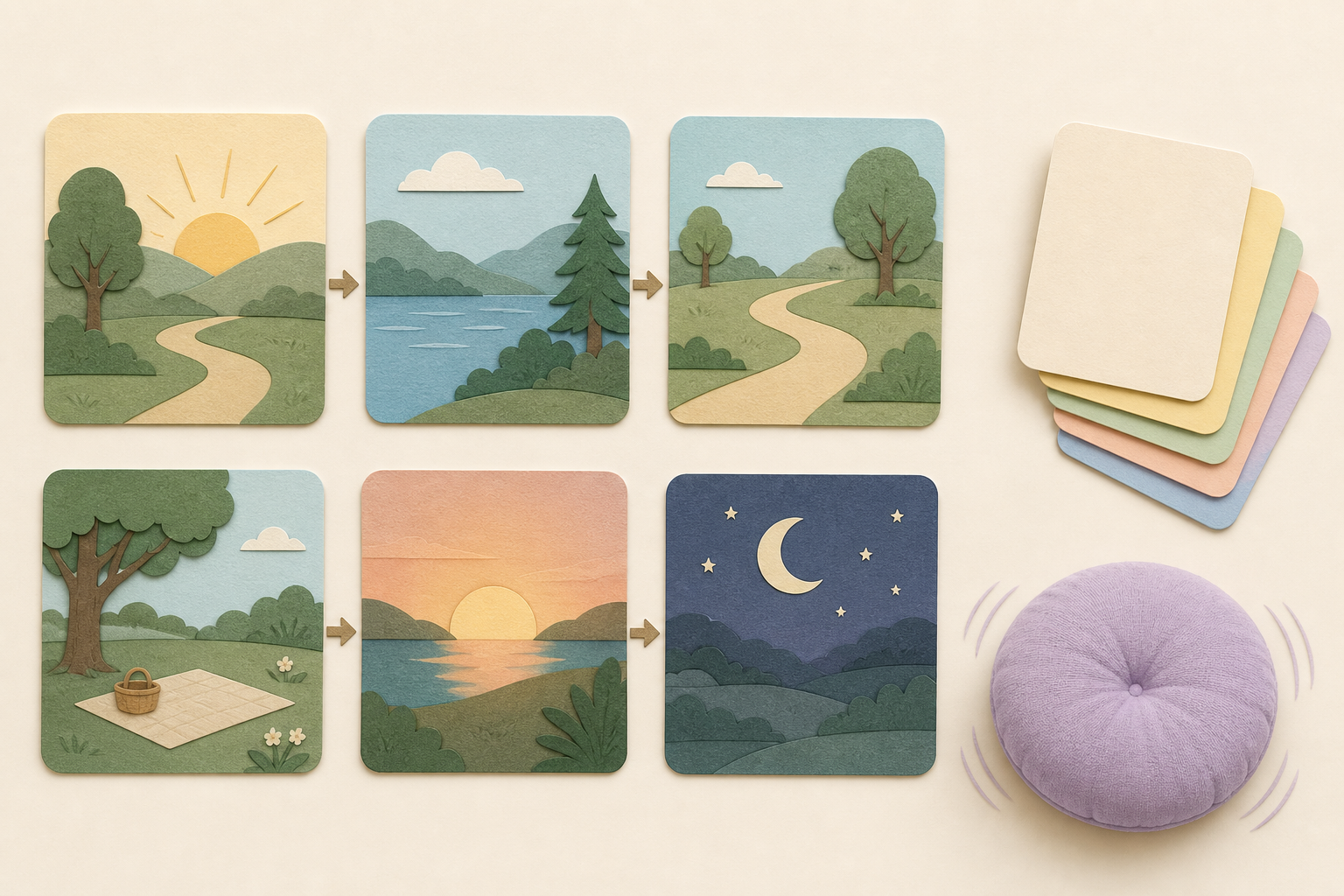
Six pictures changed how well children could retell a story. The visual prompts helped children with and without ADHD, with the biggest gains in completeness and coherence appearing in the ADHD group.
Parenting programs rarely account for a parent's own ADHD. In a separate experiment, a gently vibrating seat may have helped a new movement stick overnight.
This is the weekly roundup. Last week, we looked at the difference between feeling inattentive and remembering a wandering thought, children's descriptions of sleep trouble, a small handball study, and the limits of matching medication to a person in advance.
Six pictures helped children retell fuller, clearer stories
Researchers asked 50 children with ADHD and 46 children without it, all aged 8 to 12, to listen to two short Aesop fables. Each child retold one with six illustrations still on screen and one without them.
Overall, children with ADHD told less complete and coherent stories. They paused more and made more language errors, but they did not go off topic more often.
The pictures helped both groups include more important information and build a clearer story. The boost in completeness and coherence was larger for children with ADHD.
The important distinction is what did not change. In this task, the difficulty was missing or loosely connected parts of the story, not more detours away from it.
That points toward a different kind of support than repeating "stay on topic": reduce how much has to be remembered at once.
This happened in one controlled retelling task, not a classroom or everyday conversation. Still, the practical idea is simple: when a child needs to explain a sequence, keep the key steps visible.
A cue does not have to give the answer. It may only need to hold the next part of the story.
Parenting programs rarely account for the parent's own ADHD
Parenting programs often ask adults to remember instructions, practice between sessions, and respond consistently. Those can be difficult demands when the parent is also managing ADHD.
A program can be well designed for a child yet still be hard for a parent to carry out between sessions. That is what the reviewers went looking for.
A search for programs built around parents with ADHD found only five studies, and just two were designed to make a fair comparison between approaches.
The programs took two broad routes: adapting the training to ADHD needs or treating the parent's ADHD alongside it.
Looking beyond those five studies, the reviewers kept finding the same practical ideas: short instructions, reminders, flexible pacing, and personal support. They sound sensible, but they have not been tested together as a reliable package.
The problem is how little evidence there is. Five studies cannot show which changes work, for whom, and by how much. There is no winning formula yet.
The important gap is that parenting research has often treated the parent as the delivery system without designing for the parent's own ADHD.
A vibrating seat changed next-day motor memory in one lab task
Researchers recruited 97 adults aged 19 to 35, 65 of whom had ADHD and were not taking ADHD medication during the experiment.
Everyone practiced a short finger-to-thumb movement sequence while sitting on the same cushion. For half of each group, the cushion vibrated gently.
The vibration did nothing measurable during practice. The surprise came the next day: adults with ADHD who had felt it produced a modestly larger gain in correct sequences. The group without ADHD did not get the same boost.
They returned again one week later. The advantage still leaned in the same direction, but it was no longer clear enough to rule out chance.
This was one finger sequence in adults aged 19 to 35, not a test of studying, work, daily routines, or ADHD symptoms. That makes it an intriguing lab result, not a reason to buy a vibrating cushion.
It gives researchers a sharper question about background sensation and memory, but says nothing yet about everyday ADHD support.
What stays in sight does not have to stay in your head
The idea worth carrying from the story task is small: support does not always have to provide the answer. Sometimes it only needs to keep the next part visible.
Six pictures changed what children could hold together. The practical question is simple: what can stay in sight so it does not have to stay in your head?
Sources
- Samniya H, Haneda R, Tripp G. A Picture is Worth How Many Words? The Impact of Visual Cues on the Story Retelling of Children with and without ADHD. Research on Child and Adolescent Psychopathology, 2026.
- Lindström T, et al. A Systematic and Explorative Literature Review Investigating Parent Training Interventions For Parents with ADHD. Journal of Attention Disorders, 2026.
- Korman M, et al. Vibrotactile stimulation selectively enhances motor memory consolidation in adults with ADHD: A diagnosis-specific effect. Translational Psychiatry, 2026.
Discussion
Loading the conversation…
Open the discussion in the Recordo community