
If you have ADHD, you have probably stood in a room that needs everything done to it and done nothing, because there was no single thing to point at and start.
Most advice for getting unstuck, including every task list app, assumes you can name the task. Open the document. Load the dishwasher. Reply to the email. Type it in, check it off. A messy room does not give you a task to type in.
Every surface needs something, and none of it is more urgent than the rest. "Just start somewhere" turns out to be advice for a problem you do not have.
That is not the same difficulty as staring down one task you are avoiding. It is worth treating as its own problem, because the fix is different.
This is not task paralysis with extra steps
Task paralysis is about a named task that feels too big to enter. The fix there is to shrink it: not "write the report" but "open the document."
An unbounded mess will not shrink the same way, because there is no single task sitting at the center of it to shrink. The room does not have a first step.
It has hundreds of small, interchangeable, undifferentiated ones. Picking among them is its own kind of stuck.
What the research says this actually tracks with
It is tempting to read a messy room as task paralysis on a bigger scale. The research points somewhere more specific.
A 2023 study compared adults with ADHD, adults with OCD, and healthy controls on hoarding-type symptoms: clutter and difficulty discarding items, regardless of formal diagnosis. 32% of the ADHD group met the threshold for hoarding disorder, against 8% of the OCD group and 4% of controls.
Higher impulsivity scores tracked with more severe clutter within the ADHD group.
That does not mean a messy room means you have hoarding disorder. It means the same pattern, difficulty deciding what to do with an object and then acting on it, shows up more strongly in ADHD than in a condition people usually associate with clutter first.
An untamed room is not a worse version of a normal problem. It is a milder version of a specific, studied one.
Where the load actually goes: decisions, not muscle
Physically, cleaning a room is not hard. Picking an object up and moving it takes seconds. What makes a room exhausting is that every object carries a decision: keep it, toss it, put it somewhere, deal with it later.
A room with a hundred things out of place is a hundred small decisions stacked on top of each other, not one physical job.
A small, self-reported study of adults with ADHD found that 82% struggled frequently with decision-making, and 58% experienced decision paralysis at least once a week. The study was uncontrolled and the sample was small, so treat the numbers as a direction rather than a fixed rate.
It still lines up with the room problem directly: what runs out first is not energy, it is decision capacity.
That reframes what "just start" is actually asking you to do. It is not asking you to move an object. It is asking you to make a hundred small judgment calls with no scaffolding around any of them.
Carve by category, not by room
If the room has no task to shrink, do not sort by room. Sort by category or by container, so that each carved unit only asks you to make one kind of decision at a time instead of a hundred different ones.
Pick one category: dishes, laundry, trash, paper. Collect only that category from the whole space, ignoring everything else. Deal with that one pile before touching a second category.
This narrows the room down to a single, repeatable decision. "What do I do with this cup" repeated ten times is a much smaller decision load than "what do I do with this" asked once per random object.
There is no controlled trial comparing category-first sorting against room-by-room cleaning in ADHD specifically. This is inference, not a finding.
It follows from the decision-load pattern above, and it matches what professional organizers who work with ADHD clients report using in practice.
When it is not the room, it is one step
Sometimes the block is not the mess, it is a single step inside an otherwise easy task. Folding a shirt takes five seconds. Hanging it up does not happen. Carrying a plate to the sink is automatic. Getting it from the sink into the cupboard is not.
This is consistent with how ADHD affects working memory and inhibition together. Any one step in a short sequence can be the one where attention drops out, independent of how physically easy that step is.
If a task keeps stalling at the exact same point, that point is probably the actual block, not the task as a whole. Isolate it and start a new, smaller loop there instead of restarting from the top.
Working next to someone else, in person, on a call, or in an app, is a low-effort thing to try alongside this. The evidence is thin, mostly small studies and self-report, but the risk of trying it is close to zero.
How Recordo helps
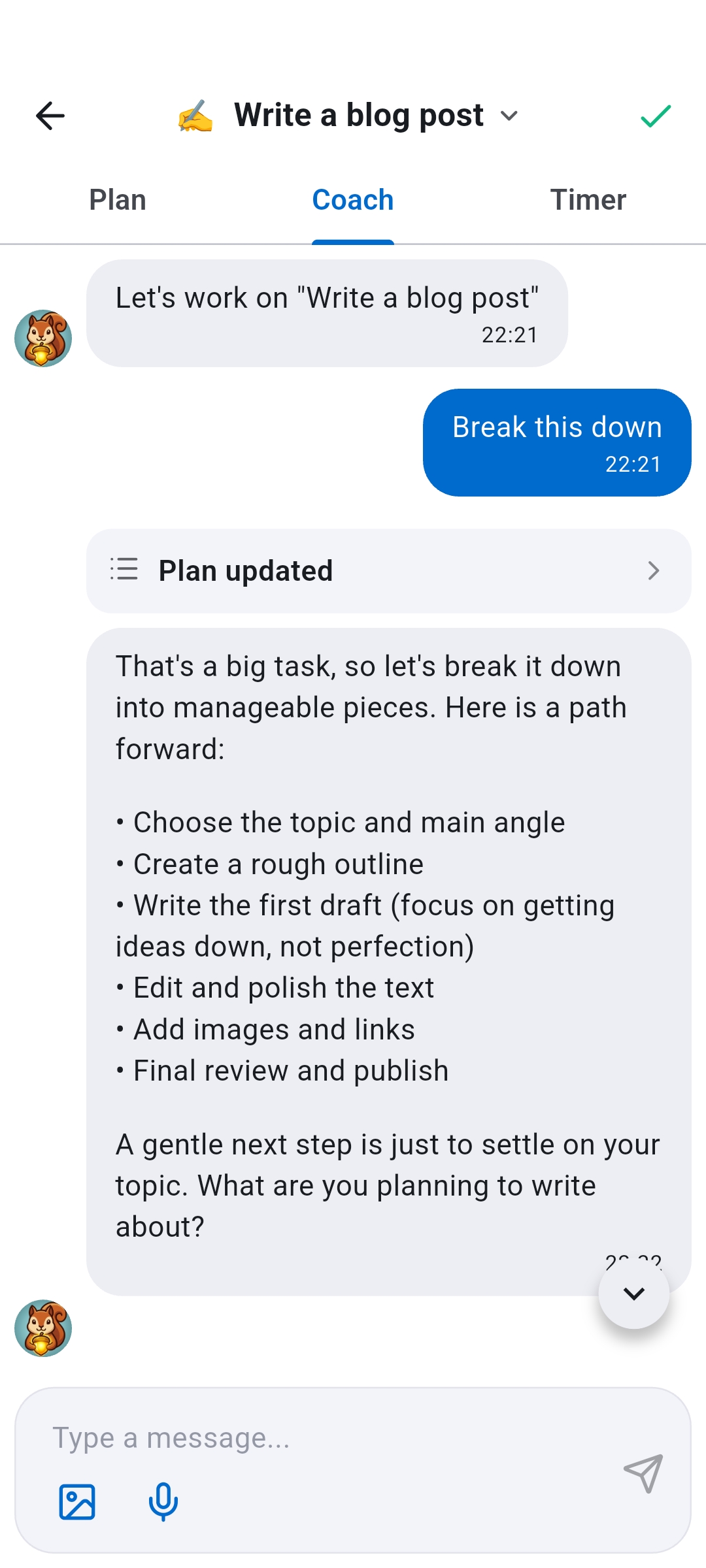
A regular task list app cannot do anything here, because it needs you to type in a task first. That is exactly the part you do not have.
Recordo's chat does not need one. Attach a photo of the room straight in the chat and describe it in your own words: "living room, no idea where to start."
The coach looks at the photo, not just the words, and can turn what it sees into separate entries on its own: dishes as one task, laundry as another, the paper pile as a third. You are not the one carving up the room. The coach is.
Once those exist as separate tasks, drop any one of them into Momentum Mode, so the checklist and timer live in the same place as the conversation that got you unstuck.
- Attach a photo in chat and let the coach propose the categories, instead of inventing a task list yourself.
- Each category becomes its own entry, "Sort dishes from the living room," separate from the rest of the room.
- If a specific step keeps stalling, add it to that entry's plan as its own line so it stops disappearing into the bigger task around it.
- If a category re-blocks every week, the laundry pile that always comes back, turn that entry into a recurring routine so it resurfaces on its own instead of you having to remember to recreate it.
Key takeaway
A room with no first step is not a bigger version of task paralysis. It is a decision-load problem wearing a laziness costume, and the fix is to carve it into single-decision units instead of trying to find one task that was never there.
Sources
- Grassi G, Moradei C, Cecchelli C, van Ameringen M. Who really hoards? Hoarding symptoms in adults with attention-deficit hyperactivity disorder (ADHD), obsessive-compulsive disorder (OCD) and healthy controls. Journal of Psychiatric Research, 2023.
- Oroian BA, Nechita P, Szalontay A. ADHD and Decision Paralysis: Overwhelm in a World of Choices. European Psychiatry, 2025.
Discussion
Loading the conversation…
Open the discussion in the Recordo community